INTERVIEW case#55 We Work HERE “新しい民主主義の形/A New Form of Democracy"
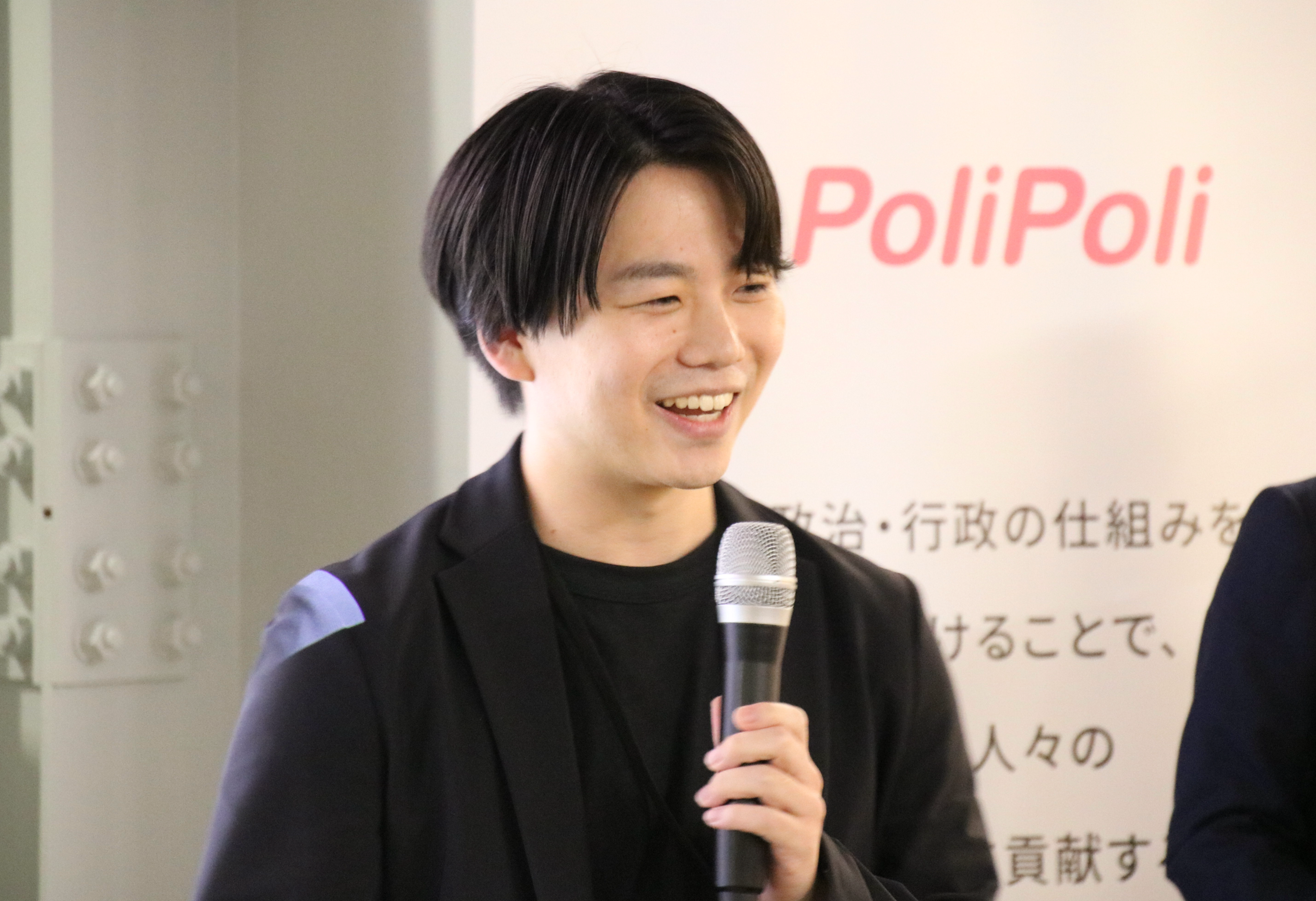
A New Form of Democracy
PoliPoli is a platform designed to enable collaborative policymaking with government, public administration, private companies, and NPOs. It is used by four of the five major political parties and about 30% of central government ministries, and it is also involved in rulemaking for employment policies in the private sector.
In a representative democracy, people vote once every three or four years in House of Representatives elections, simply writing down a politician’s name—that’s it. That feels like an overly coarse form of public feedback. On the other hand, a direct democracy where citizens must understand and respond to every policy is not realistic either. As a middle ground, we aim to create a system where people can entrust a certain level of responsibility to politicians and bureaucrats, while still being able to meaningfully engage with policies they care about, whenever they choose. We call this “digital democracy.” By leveraging digital tools, we believe society can become one where people can engage more seamlessly with politics and policy. The idea that individuals can help shape their communities and even the nation—improving people’s lives—is incredibly compelling. Through a service called Policy Fund, we also provide a platform that enables private companies to contribute to solving social issues.
We place “overwhelming agility” as our top value, constantly running PDCA cycles while approaching things from PoliPoli’s unique perspective. In today’s world, not only governments and public institutions but also local governments, companies, NPOs, and individuals must all create social impact. While boundaries are becoming blurred, diverse stakeholders are working to improve society. PoliPoli aims to be—and continue to be—the platform that brings them together.
Embracing Complexity and Contradiction Builds Stronger Organizations
We have been based in MIDORI.so since the days of Nagatacho GRiD. Originally, we had an office in Kamakura, but since we need to meet politicians face-to-face—and after experiencing remote work during COVID—we felt the importance of gathering offline again. Given that we work in politics and public administration, Nagatacho is a crucial location. Traditional office leases often lock you into fixed contract periods, but startups face constant growth and uncertainty. Shared offices offer the flexibility needed to handle such volatility, which is a practical advantage.
At the same time, although we operate in the traditionally rigid field of political economy, we believe it’s precisely because startups have not focused much on this area that we must explore new business approaches. Creativity means generating significant impact through perspectives and approaches that didn’t exist before. In that sense, PoliPoli is a creative company, and MIDORI.so itself is a creative space—its culture was a key reason we chose to move in.
Being surrounded by diverse members here gives a real sense of “society.” There’s a concept called “no surprise,” where simple management structures tend to grow best. Ideally, you minimize chaos and negative surprises. From that perspective, it’s important for a company to maintain a strong internal culture within its own office. However, such stability can collapse instantly if market conditions change. As a platform provider serving a wide range of users, we believe that having diverse people is precisely what enables us to create valuable services. Embracing complexity and contradiction may take time, but it leads to stronger outcomes. Life itself is complex and full of contradictions. That’s why MIDORI.so feels like a small village—where a certain level of chaos fosters diversity.
Accumulating Small Wins
With the rise of the internet and social media, anyone can now share their voice. Crowdfunding and online stores can be launched easily. While individual empowerment is accelerating, politics and public administration have struggled to keep up. Before founding the company, I personally had little interest in politics—it felt “big and rigid.” But we need a society where individuals can engage more with policymaking.
At the national level, decisions affect over 100 million people, making it difficult to quickly change laws or move budgets worth hundreds of billions of yen. However, there is room to influence ministerial ordinances and how systems are operated. At PoliPoli, we are currently able to move at least one policy per month, and we’ve seen that well-founded ideas can indeed lead to change.
It’s important not to give up on the belief that raising your voice will eventually lead to change. Even though countless proposals and ideas are submitted every day, only a small percentage materialize. Whether it’s collecting signatures or influencing policy, achieving immediate results is difficult. But accumulating small victories—like having your voice reach a ministry or a politician—is incredibly important.
At the same time, working only on upstream policy through PoliPoli can feel intangible on a personal level. That’s why on weekends, I volunteer—cleaning at children’s cafeterias or picking up trash in the community. These experiences reinforce the importance of policy. Both on-the-ground action and policymaking are essential.
Without Passion, a Business Cannot Continue
I believe all businesses begin with a sense of romance or aspiration. Having met many entrepreneurs and explored business ideas myself, I’ve learned that only businesses driven by genuine passion can endure. In PoliPoli’s early years—around the first three years—none of our initiatives worked, and it was quite difficult. But the service we have today actually emerged from a poem I wrote when I was stuck.
Some people can succeed purely through logical thinking, but I need emotional investment to move forward. I think truly great ideas come from deeply embedding your own passion into them. The strong conviction of an entrepreneur—thinking “I’d be satisfied even if I died after creating this”—is what draws people in.
Work as Self-Realization
As the founder, my company represents my purpose in life, and “working” is a form of self-realization. Before starting my business, I had various career options: I created a haiku social media platform and sold it to Mainichi Newspapers, worked in venture capital, and gained some engineering experience. But when I thought about creating diverse futures, I realized that the field of politics and public administration is the last frontier.
It’s a domain filled with challenges, but it also forms the foundation of society. If this area changes, society itself can improve. That belief—and the fascination with that possibility—is what keeps me going today.
Notes
- PoliPoli: A platform that helps users understand trending policy issues, discover policies to engage with, contribute to policymaking, and track progress.
- Policy Fund: A funding mechanism provided by PoliPoli to achieve specific policy goals, supported by governments, public institutions, and nonprofits.
- PoliPoli Gov: A governance platform that connects citizens with policymakers, allowing users to propose ideas, vote, and influence policy priorities.
- Haiku SNS: A social media platform created by Ito during university, designed to make haiku accessible. It was later acquired by Mainichi Newspapers.
Profile: Kazuma Ito
CEO of PoliPoli and Co-Representative of the Govtech Association. Born in 1998 in Aichi Prefecture. In 2018, while studying at Keio University, he launched the haiku app “Haiku TeFuTeFu,” which was later acquired by Mainichi Newspapers. In the same year, he founded PoliPoli and released the policy co-creation platform “PoliPoli.”
MIDORI.so Newsletter: